Ireland
31 Oct · Oíche ShamhnaBonfires, barmbrack fruit bread with a hidden ring foretelling marriage, and apple games. Derry~Londonderry hosts a large city-wide Halloween festival.
The Encyclopedia of Halloween, Haunted Places & Strange Traditions
A chaptered guide to the season — tracing the documented roots of Halloween and the remarkable variety of ways the world remembers its dead, scares itself and celebrates the turning of the year.
Halloween did not spring from a single source. Its date lies alongside Samhain, a seasonal festival described in early medieval Irish literature as the end of summer and the start of the darker half of the year. These texts link Samhain with assemblies, feasting and the idea that the boundary with the Otherworld grew thin.
Claims that Samhain was the “Celtic New Year” or a festival of a “god of the dead” are often repeated but are not well supported by the sources. Much of what we know was written down by Christian scribes centuries after the pre-Christian era, so historians treat details with caution.
The name comes from the Church. All Saints’ Day (All Hallows) was fixed on 1 November in the Western Church by the 9th century, and All Souls’ Day on 2 November spread from the abbey of Cluny around the year 1000. The evening before All Hallows — All Hallows’ Even — became “Hallowe’en”, a form popularised in Scots.
Folk customs grew around this cluster of days: bonfires, divination games with apples and nuts, souling and guising. Irish and Scottish emigrants carried them to North America, where they merged with harvest festivities and, by the 20th century, commercial celebrations.
Medieval Irish tales place major events at Samhain, often involving the Otherworld.
Pope Boniface IV dedicates Rome’s Pantheon to Mary and all martyrs on 13 May — an early “all saints” feast.
Pope Gregory III dedicates a chapel in St Peter’s to all saints, associated with 1 November.
Under Pope Gregory IV, All Saints’ Day on 1 November is extended across the Western Church.
Odilo of Cluny establishes 2 November for prayers for the dead; the custom spreads widely.
The term appears in English writing; the contracted “Hallowe’en” becomes common later via Scots.
Robert Burns’ poem documents Scottish divination games and is published in 1786.
Irish painter Daniel Maclise depicts a Halloween party with apple games in Blarney.
Irish emigration to North America carries Halloween customs across the Atlantic.
A Kingston newspaper describes children guising — the earliest known North American record.
The phrase appears in an Alberta newspaper, the earliest known printed use.
U.S. rationing curbs candy-based customs; trick-or-treating expands rapidly after the war.
New York’s Village Halloween Parade begins, growing into one of the world’s largest.
UNESCO inscribes Mexico’s indigenous festivity dedicated to the dead on its Representative List.
Many cultures mark late October and early November — or other times of year — with remembrance of the dead. Some celebrate Halloween; others keep entirely separate traditions that simply share the season. Filter by region:
Bonfires, barmbrack fruit bread with a hidden ring foretelling marriage, and apple games. Derry~Londonderry hosts a large city-wide Halloween festival.
Children go “guising”, performing a song, poem or joke for treats, and play “dookin’ for apples”. Carved turnip “neep” lanterns remain a cherished tradition.
Trick-or-treating, pumpkin carving, costume parties and haunted attractions. Salem, Massachusetts, marks the whole month with events linked to its 1692 witch-trial history.
Home of the earliest recorded North American guising (1911) and the first known printed “trick or treat” (1927). Celebrated much as in the US.
Families build ofrendas with photographs, cempasúchil marigolds, candles, sugar skulls and pan de muerto to welcome the dead. Distinct from Halloween in meaning.
In Sumpango and Santiago Sacatepéquez, communities fly or display enormous kites in cemeteries; families share fiambre, a cold salad of many ingredients.
A Vodou festival honouring the Gede spirits of the dead, led by Baron Samedi, with cemetery visits, music and offerings.
Cemetery visits, huesos de santo marzipan and buñuelos. Theatres stage José Zorrilla’s 1844 play Don Juan Tenorio. Galicia revives Samaín with carved squashes and queimada.
Families visit graves and bake fave dei morti biscuits. In Sicily, children traditionally receive gifts said to come from deceased relatives.
Cemeteries glow with thousands of candles (znicze) as families tend graves — one of Europe’s most striking remembrance scenes.
Halloween spread mainly from the 1990s; 31 October is also Reformation Day. Burg Frankenstein near Darmstadt has hosted Halloween events for decades. Some Austrian families traditionally leave bread and water out for souls.
Families travel to cemeteries to clean graves, share food and keep vigil. The old custom of pangangaluluwa involved singing door to door on behalf of souls.
Halloween costume gatherings grew from the late 1990s, notably Kawasaki’s parade; Shibuya has recently restricted street events. Ancestral spirits are honoured in summer during Obon.
Offerings of food and burnt joss paper appease wandering spirits during the Zhongyuan / Yulan festival. Halloween is mainly a theme-park and party event.
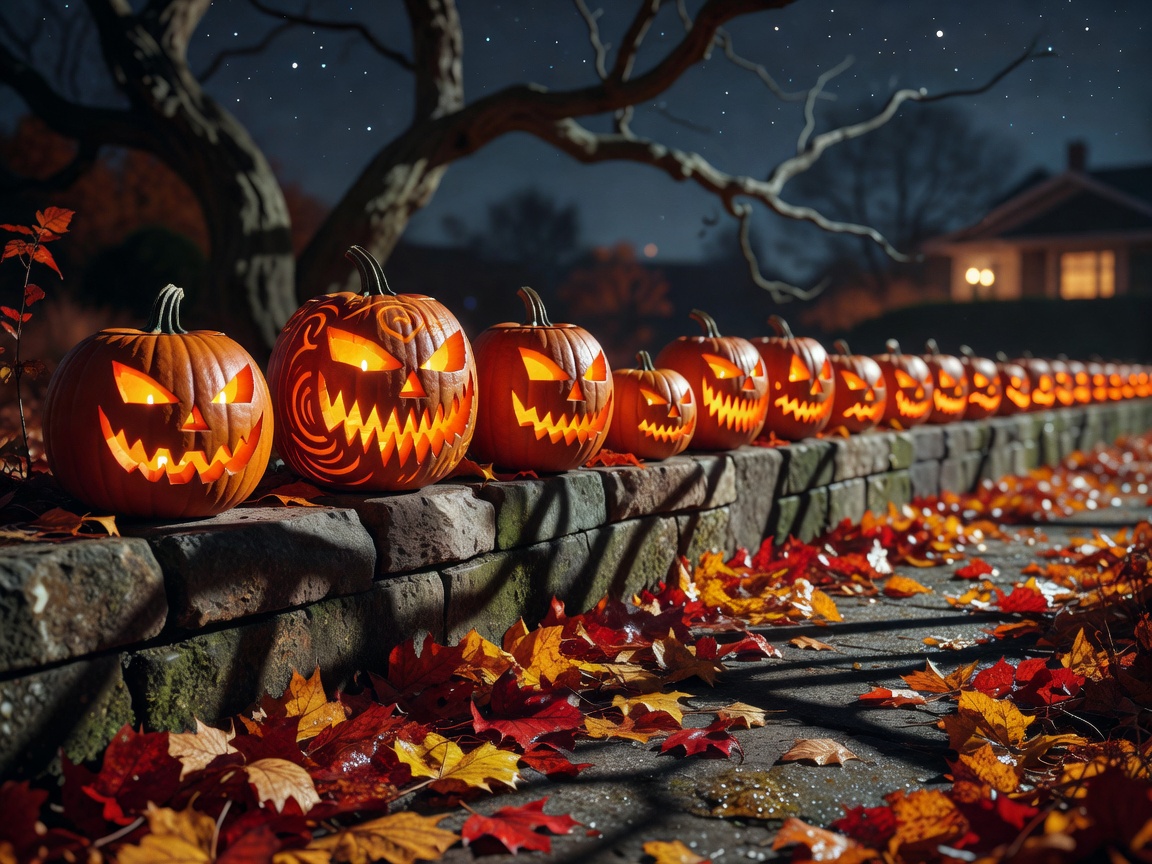
“Jack-o’-lantern” first meant a night watchman, then the marsh light called will-o’-the-wisp. Carved turnip lanterns in Ireland and Scotland gave way to pumpkins in America. The Irish tale of Stingy Jack explains the name in folklore.
Early modern witch-trial pamphlets linked cats with witchcraft. Superstitions vary: in parts of Britain and Japan a black cat can be lucky.
Bobbing for apples, peeling an apple to see a future spouse’s initial and burning nuts on the fire were all divination games recorded by Burns and others.
The colours were popularised by early 20th-century greeting cards, party guides and decorations, suggesting harvest and darkness.
Skulls and skeletons echo the late-medieval Dance of Death and the idea of memento mori — remember you will die.
One explanation is that bonfires drew insects and thus bats. It is plausible but unproven; bats were also long associated with night and witchcraft.
The pointed black hat owes much to 19th-century illustrations and later films; its exact origins are debated.
Candy corn dates to the 1880s, but packaged sweets only became the default treat in the US from the 1950s.
Disguise has a long seasonal history. Medieval mummers performed masked plays in winter; Scots and Irish guisers visited neighbours in costume on Halloween. Early costumes were homemade: blackened faces, sheets, old clothes and turnip lanterns.
In the 1930s, American companies such as Ben Cooper and Collegeville began mass-producing costumes and masks, increasingly based on cartoon and film characters. From the 1970s, adult costume parties and parades grew rapidly.
Today, many communities encourage costumes that avoid stereotypes of real cultures and religions — a reminder that Halloween fun works best when it includes everyone.
| Food | Where | Tradition |
|---|---|---|
| Barmbrack | Ireland | Fruit loaf with a hidden ring; finding it is said to foretell marriage. |
| Colcannon | Ireland | Mashed potato with kale or cabbage, sometimes hiding coins or charms. |
| Soul cakes | England | Spiced cakes given to “soulers” who prayed for the dead. |
| Pan de muerto | Mexico | Sweet bread decorated with dough “bones”, placed on ofrendas. |
| Huesos de santo | Spain | Marzipan “saints’ bones” filled with sweet yolk for All Saints’ Day. |
| Fave dei morti | Italy | Almond biscuits shaped like beans, an old symbol associated with the dead. |
| Fiambre | Guatemala | A cold, multi-ingredient salad shared on 1 November. |
| Toffee / candy apples | UK, North America | Sugar-coated apples linked to harvest season and Bonfire Night. |
“Ghost town” usually means a settlement abandoned for economic or environmental reasons — not a haunted one. Their stories tell us about mining booms, disasters and changing industries.
Preserved as a state historic park in a state of “arrested decay”, with buildings left much as residents abandoned them.
A once-prosperous diamond-mining settlement deserted in the mid-20th century; desert sand now fills its houses.
Largely evacuated after a landslide in 1963; its silhouette has appeared in many films. Visits are by guided tour.
Closed in 1974 and part of a UNESCO World Heritage listing since 2015 — with a contested history of wartime forced labour.
Evacuated after the 1986 nuclear disaster. Access is tightly restricted and currently not a tourist destination.
Many famous “haunted” sites are also prisons, graves and places of real suffering. A thoughtful visit is more rewarding — and keeps these places open.
Every year on 31 October, the eve of All Saints’ Day (1 November).
The apostrophe marks the contraction of “even” (evening) in “All Hallows’ Even”.
No. Pumpkins are native to the Americas. Carved turnips and other root vegetables are recorded in Ireland and Scotland, mostly from the 19th century.
Research by sociologist Joel Best found no confirmed cases of strangers randomly poisoning children’s Halloween candy. See urban legends.